
Home Equity Loan Calculator
Calculate home equity loan payments online free — fixed rate, term and total interest for lump-sum borrowing. In-browser processing — no upload, no account.
How much can you borrow against your equity?
- Maximum you can borrow$148,000
- Equity you hold today$220,000
- Current loan-to-value54.17%
- Monthly payment on the maximum$1,457.41
- Total interest over the term$114,335
- Combined debt after borrowing$408,000
Calculated in your browser — nothing you type is sent anywhere.
How much equity is actually available
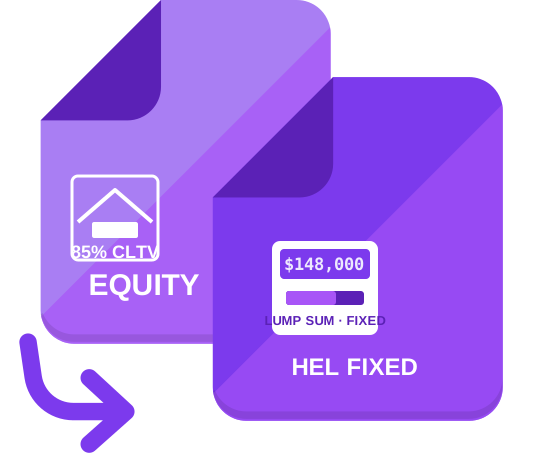
Equity is your home value minus what you still owe, but lenders will not let you borrow all of it. They apply a maximum combined loan-to-value ratio, usually 80% to 90%, across the first mortgage and the new loan together. On a $480,000 home with $260,000 owed and an 85% cap, the lender will allow $408,000 of total debt, leaving $148,000 available to borrow.
The calculator applies that cap, reports the borrowable amount, the fixed monthly payment over your chosen term, the total interest, and the combined loan-to-value you would end up at.
Home equity loan versus HELOC
- Home equity loan. One lump sum, a fixed rate, and equal payments for the whole term. Predictable, and the right tool for a known one-off cost.
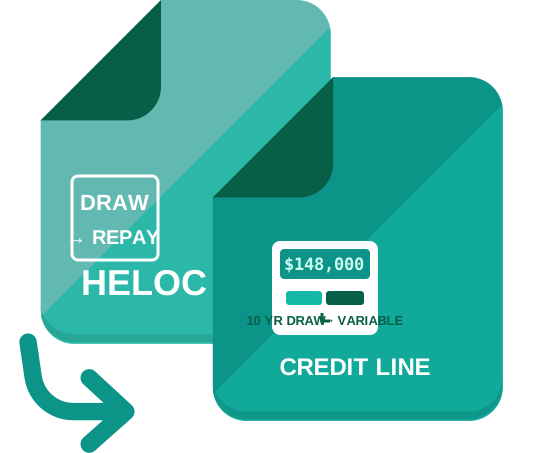
- HELOC. A revolving credit line at a variable rate, drawn as needed, usually interest-only during a draw period. Flexible, and riskier if rates rise.
If you know the exact amount you need today, the fixed loan is almost always the better instrument. If the spend is staged over years, such as a renovation in phases, the line of credit avoids paying interest on money you have not used.
The risk that makes this different from other debt
A home equity loan is secured against your house. That is why the rate is far below a credit card or personal loan, and it is also why default leads to foreclosure. Converting unsecured debt into secured debt lowers the interest rate and raises the stakes. Do it only when the payment is comfortably sustainable.
Interest may be tax-deductible when the funds are used to buy, build, or substantially improve the home securing the loan. Using the money for other purposes generally removes that deduction. Confirm with a tax professional for your situation.
Frequently Asked Questions
How much can I borrow against my home?
Typically enough to bring your total mortgage debt to 80% to 90% of the home value. Subtract your current balance from that ceiling. The calculator does this for whatever cap your lender applies.What credit score is needed for a home equity loan?
Most lenders want 620 as a minimum and reserve the best pricing for 700 and above. Debt-to-income ratio and verified equity matter just as much as the score.Is a home equity loan better than a personal loan?
The rate is far lower because the loan is secured by your house, and the terms are longer. The trade-off is that a personal loan cannot cost you your home.Do I need a new appraisal?
Usually yes, though some lenders accept an automated valuation for smaller loans with plenty of equity. Appraisal cost is part of the closing costs on a second mortgage.Is the interest tax-deductible?
It can be when the funds are used to buy, build or substantially improve the home that secures the loan, subject to the overall mortgage interest limits. Using the money to consolidate other debt generally does not qualify.What happens if I sell the house?
Both the first mortgage and the home equity loan must be paid off from the sale proceeds at closing. If the sale price does not cover both, you must cover the shortfall.Are there closing costs?
Yes, though they are much lower than a first mortgage. Expect 2% to 5% of the loan, and some lenders waive them in exchange for a rate premium or a minimum holding period.