HELOC Calculator
Calculate HELOC payments and interest online free — draw period, repayment phase and variable rate scenarios. In-browser processing — no upload, no account.
HELOC credit line and payments
- Credit line available$148,000
- Interest-only payment during the draw period$437.50
- Payment once repayment starts$530.23This jump at the end of the draw period is what catches most borrowers out.
- Amount drawn used in this estimate$60,000
- Payment increase at the switch$92.73
- Interest cost if rates rise 2 points$537.50 / mo (interest-only)
Calculated in your browser — nothing you type is sent anywhere.
How a HELOC is structured
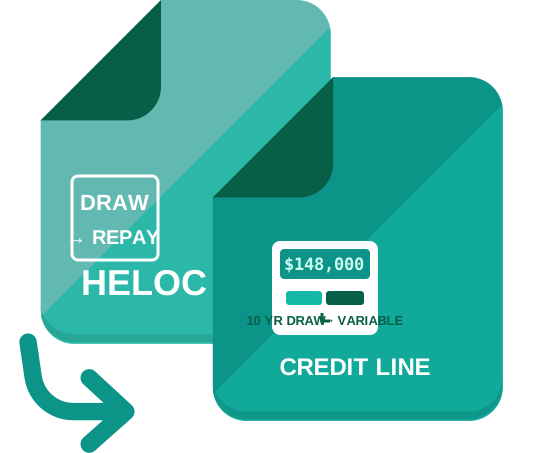
A HELOC is a revolving credit line secured by your home. The lender approves a maximum limit based on your equity, and you draw against it as needed. It runs in two distinct phases, and the difference between them is where most borrowers get caught.
- The draw period, usually ten years, during which you can borrow and repay freely and payments are often interest-only.
- The repayment period, usually ten to twenty years, during which drawing stops and the balance must fully amortise.
The calculator reports your credit limit, the interest-only payment during the draw, the amortising payment once repayment starts, and the size of the jump between the two.
The payment shock at the end of the draw
Interest-only payments during the draw are attractive precisely because they are small, and they pay off nothing. On a $60,000 balance at 8.75%, the interest-only payment is around $438. When repayment begins over twenty years, the payment becomes roughly $530, and over ten years it is close to $752. Borrowers who budgeted around the draw payment are the ones who struggle.
The rate is also variable on almost all HELOCs, tied to the prime rate. A two-point rate rise on a large balance moves the payment immediately, with no fixed-rate protection.
When a HELOC is the right instrument
Use a line of credit when the amount and the timing are both uncertain: a staged renovation, a business with lumpy cash needs, or a standby reserve you may never draw. Use a fixed home equity loan when you know the number today. Never use a HELOC to fund ongoing living expenses; the collateral is your house.
Many lenders allow you to convert part of a drawn balance to a fixed rate. If you have drawn heavily and rates are rising, ask about that option before the repayment period begins.
Frequently Asked Questions
What is the difference between a HELOC and a home equity loan?
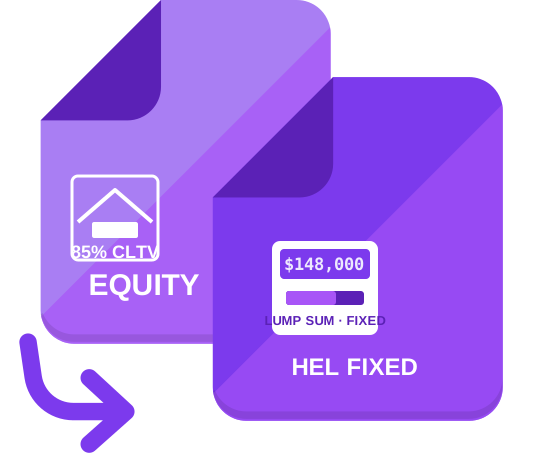
A home equity loan is a single lump sum at a fixed rate with equal payments. A HELOC is a revolving line at a variable rate that you draw from as needed, typically interest-only for the first ten years.How is my HELOC credit limit calculated?
The lender multiplies your home value by a maximum combined loan-to-value ratio, usually 80% to 90%, then subtracts your existing mortgage balance. The remainder is the line.What happens when the draw period ends?
You can no longer borrow, and the outstanding balance must be repaid with principal and interest over the repayment period. Payments typically rise sharply, which is the payment shock shown above.Is a HELOC rate fixed or variable?
Almost always variable, tied to the prime rate plus a margin. Payments move when the prime rate moves. Some lenders offer a fixed-rate conversion option on part of the balance.Do I pay interest if I never draw on the line?
No. Interest accrues only on the amount actually drawn. Some lenders charge a small annual or inactivity fee for keeping the line open.Can a lender freeze or reduce my HELOC?
Yes. If your home value falls or your financial position deteriorates, lenders can reduce or freeze an undrawn line. This happened widely in 2008 and is a real risk if you are relying on it as an emergency reserve.Is HELOC interest tax-deductible?
Only when the funds are used to buy, build or substantially improve the home securing the line, subject to the overall mortgage interest limits. Check with a tax professional.